Family Memory Scrapbook Pages: Ideas for Everyday Moments
Everyday photos need a structure to hold them together. These generic layouts include a four-photo grid, a paper family tree, a week-in-the-life page and then-and-now pairs.
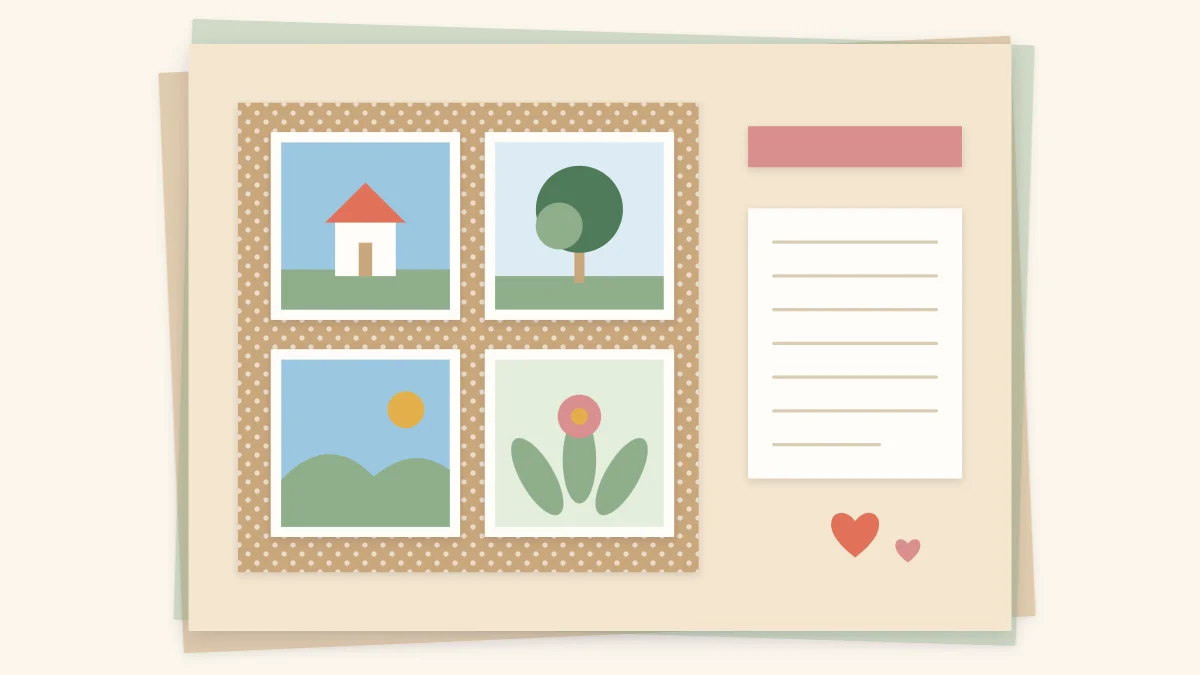
Tutorial at a glance
Materials
- cream or neutral cardstock for the page base
- kraft cardstock for a tree trunk or mats
- sage, rose or denim cardstock scraps
- photo copies, including small portraits
- paper trimmer and scissors
- circle punch or a round object to trace
- tape runner
- pencil, ruler and pen for journaling
Family memory scrapbook pages do not need an occasion. The photos that become most interesting later are often the unremarkable ones: the front door, the garden in an ordinary month, the corner where everyone drops their shoes. Because nothing dramatic is happening in them, these photos need a layout that gives them a reason to sit together.
The ideas below are generic structures for everyday material. Each one says how many photos it takes, how to arrange them and what to write, so you can match it to whatever prints you have.
What counts as an everyday moment
If you are unsure what to photograph or pull from a box of prints, look for subjects that will change without anyone noticing:
- rooms as they are now, including the untidy parts;
- regular routines such as the walk to school, homework at the table or watering plants;
- pets, favorite toys, a well-used chair;
- the house, street or view from a window in different seasons;
- hands at work on a hobby or a repair.
A mix of wide, medium and close-up shots keeps a page from feeling repetitive. If you have far too many candidates, editing down the stack before you start saves a lot of rearranging.
A grid of four with a journaling card
The simplest family page is a block of four equal photos, two by two, with a lined journaling card beside or below it. Choose four prints that share a place or a day, such as the house, a tree in the yard, a table set up for a game and the garden. Trim them to the same size and keep the gaps even.
Warm, quiet colors suit this kind of page: kraft, dusty rose and sage on a cream base. One small accent, such as a paper heart overlapping a corner of the journaling card, is enough. The grid keeps four unrelated-looking photos orderly, and the card explains what connects them.
A family tree page
A tree page shows relationships at a glance and works as an opening page for a family album. Cut a simple trunk with two or three branches from kraft cardstock and glue it in the center of the page. Cut leaf shapes from sage paper and arrange them around the branches, overlapping slightly, to form the crown.
Trim five small portraits into circles and set them among the leaves, tucking the edge of each circle under a leaf so the photos look as if they belong to the tree. Place older generations higher or lower consistently and keep that rule on every tree page you make. Write each name on a small strip beneath its photo, with dates if you want them recorded.
Five photos is a comfortable number on one page. For a larger family, make one tree per branch of the family instead of shrinking the circles until faces are hard to recognize.

Watch out
Old family portraits are often the only print in existence. Cut circles from copies, never from originals, and keep the originals or digital scans stored separately.
A week-in-the-life page
This layout records one ordinary week with one photo per day. Divide the page into a row of seven narrow columns of equal width, leaving a small gap between them and a margin at the top for a title strip. Trim one small photo for each column and glue it near the top, then rule two light pencil lines beneath each photo for a note.
The narrow format forces tight crops, which helps: cut each photo down to the single thing that mattered that day. The notes can be as short as a few words. The interest comes from the sequence, so resist adding embellishments between the columns. A cool, even palette such as denim and sky blue keeps seven small photos looking like one set. Guidance on trimming prints this small is in how to crop and mat photos.
The same structure adapts to other spans: twelve columns across a spread for the months of a year, or four wider columns for the seasons, using the palettes in seasonal scrapbook layouts.

Then-and-now and routine pages
Two more structures suit everyday subjects. A then-and-now page pairs two photos of the same place or person taken at different times. Mat them identically, set them side by side at the same height and let the journaling describe what changed. Matching mats matter here because they tell the viewer the two photos are meant to be compared.
A routine page breaks one regular activity into three or four steps shown in a horizontal row, read left to right. A morning routine, a weekend chore or a bedtime ritual all fit. Number the photos with small paper circles if the order is not obvious.
What to write on everyday pages
Everyday photos depend on journaling more than event photos do, because nothing in the picture announces why it matters. Useful details include who is pictured and how old they were, where the photo was taken, what usually happened at that time of day and anything said often enough to be a family phrase. For ways to fit longer text onto a page, see where to put the words on a page.
Tip
Ask another family member to add a line in their own handwriting. Different handwriting on the same page becomes a record in its own right.
Choosing a structure
| Page idea | Photos needed | Best for |
|---|---|---|
| Grid of four with journaling card | 4 | One place or one ordinary day |
| Family tree | About 5 small portraits | Opening page of a family album |
| Week in the life | 7 | Recording routines over a set span |
| Then and now | 2 | Showing change in a person or place |
| Routine in steps | 3 or 4 | One repeated activity told in order |
Frequently asked questions
What should go on a family scrapbook page?
Photos of ordinary places, routines and people, a short title and journaling that names who is pictured, where and roughly when. Everyday photos rely on the written part more than event photos do, so leave real space for it.
How do you make a family tree scrapbook page?
Cut a simple trunk and branches from kraft cardstock, add overlapping paper leaves, and set small round portraits among the leaves with a name strip under each. Keep to about five photos per page and use copies of old portraits instead of cutting the originals.
What is a week-in-the-life scrapbook page?
It is a layout with seven equal columns, one for each day, each holding a small photo and a short note. The format records routine instead of events, and it can be stretched to months or seasons by changing the number of columns.